
DecaLeap CRM — a complete system for customers and sales,
with detailed dashboards for managers and staff.
And optional modules on top: tasks and projects, logistics, finance, sales commissions, suppliers, and running your E-Commerce storefront. All of it in one system — and one true picture of the organisation.
No credit card · cancel anytime
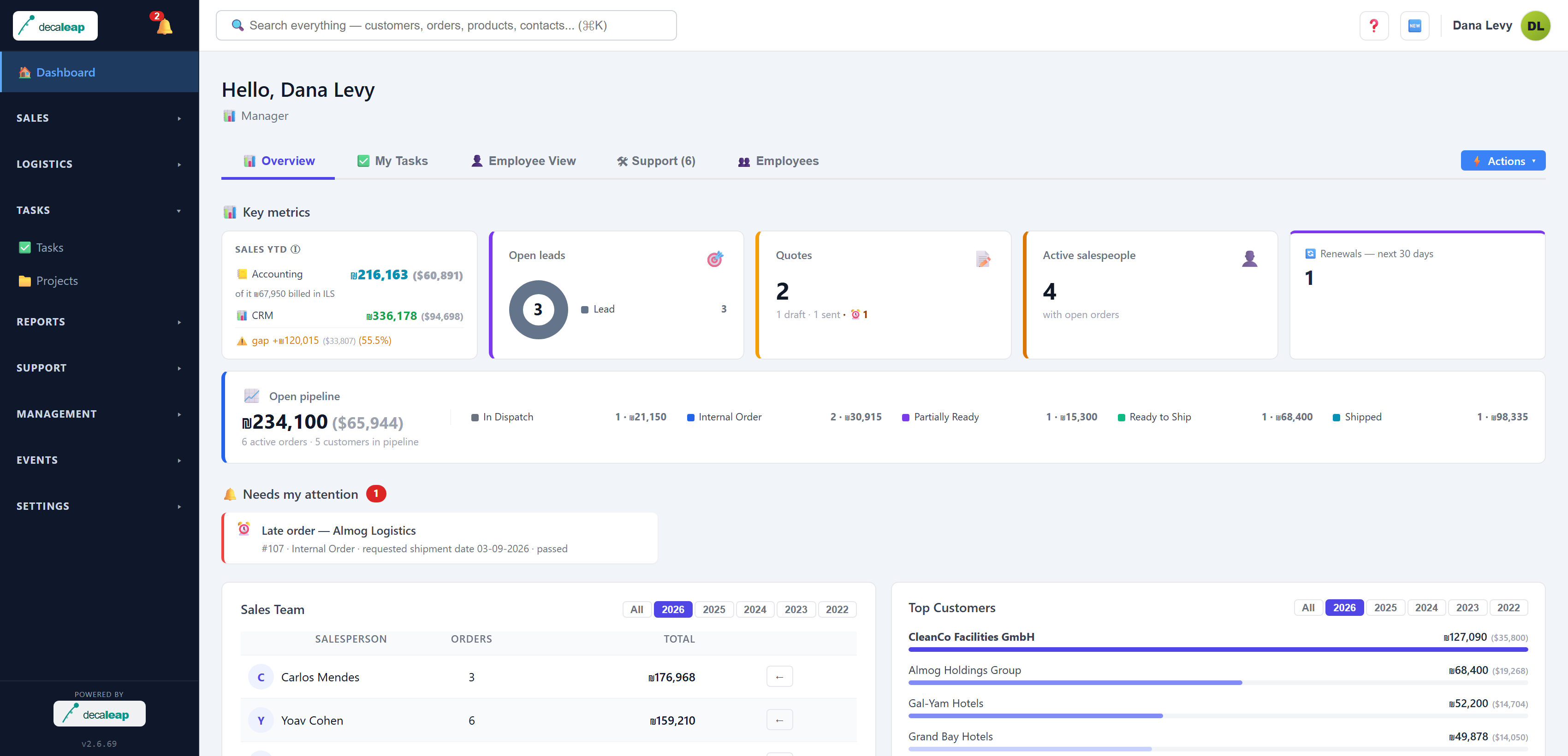
The dashboard — everything that needs attention, by the user’s role
Most businesses are not short of software.
They have too much of it.
A spreadsheet for pricing, one system for orders, another for the warehouse, a file for commissions, and accounting software nobody talks to. Every hand-off between them is a place where information falls through.
The quote came out of a spreadsheet
The order was recorded somewhere else, and the agreed price is not what the invoice says.
The warehouse cannot see priority
It lives in the sales manager’s head, not in a system.
Commissions are calculated by hand
A monthly spreadsheet, arguments with reps, and nobody is certain what was paid.
The books are disconnected
Export, map, paste — and end up with two different numbers for the same month.
Five things that finish
inside the system.
Not a feature list. Five points where the work finishes instead of spilling out — into a spreadsheet on the side, a second vendor, or another system that then has to be reconciled with this one.
A customer price and a reseller price on the same quote
On a channel sale the quote carries both: the customer price is the field you edit, and the reseller price is derived from it by the reseller’s group — so the two numbers cannot contradict each other. The invoice is addressed to the reseller, who is the party billed, while the end customer is named on it and goes on as the ship-to. Sell-through reporting shows what moved through each reseller and which end customer it reached, not only what they bought from you.
Goods on a pallet and a licence in an email — one order
The same order carries a physical product with its carton, weight and waybill, and beside it a licence key with a renewal date that goes out by email. Both land on the same invoice, the same customer record and the same report. When the renewal falls due the system prices a renewal quote from the current price list rather than from the old order line.
The people who did the work get paid inside the same system
A rep, a freelancer, a contractor or an instructor: the agreement, the invoice they submitted, the transfer that went out and its reference all sit on one person record, with multi-step approval before money leaves. Commission is separated from salary in the arithmetic, so a monthly payroll transfer does not net off commission already earned, and year-to-date reconciliation says what accrued against what was paid. The system that recorded the sale is the one that pays for it.
Every customer reads your paperwork in their own language
Language is a field on the contact, so a quote, an invoice, a delivery note or a payment reminder is produced in the language that person reads, rather than written in yours and translated afterwards. You choose which languages your company works in, from fourteen including right-to-left ones, and the standing texts every document carries (payment terms, bank details, a country-of-origin declaration) are kept separately in each. The interface itself runs in four, so the salesperson in one country and the buyer in another are each reading their own. Right-to-left is handled in the PDF itself, so the document arrives laid out correctly and not merely spelled correctly.
Domestic or export follows the customer, not whoever is typing
The customer’s billing profile decides whether an order is domestic or export, and the VAT treatment, currency and documents follow from it. Shekels and dollars can sit on one order with the conversion rate frozen per document at its own date, and document numbers run in series with a register that shows where one is missing. A business selling at home and abroad runs both in one system and one set of books.
One Core, 10 modules around it.
Core is a complete CRM — customers, sales and pricing — and every user has it. Around it sit the modules, each standing on its own and fitting with the others on the same data. Your edition decides which are open, and inside the system access is still granted per employee.
Core
- Customers, contacts and company hierarchy: parent, child, Ship-To, intermediary — with a dedicated mailbox for accounting and for delivery updates
- Orders with a full lifecycle from quote to delivery
- Multi-language quotes, invoices, delivery notes and RMAs
Pricing & Catalog
- Product families, quantity tiers and a per-family discount curve
- Promotions and discounts per product, per family and per customer — and a promotion can be marked "offered only", so it is shown to the salesperson and never applies itself
- Variant builder with automatic SKUs from a scheme you define
Accounting Sync
- Monthly import from your accounting system — Excel and PDF
- Visual column mapping: any report format, no code
- Automatic customer-name matching, create a customer inline
Israeli accounting — in formal licensing with the authorities. It will be listed here once licensing is complete; uniform-format export is already available in the core.
Tasks & projects
- Tasks and subtasks at any depth, with automatic status roll-up to the parent
- A project with a goal, milestones, a lead and a team — and a task becomes a project in one click
- A kanban board with drag-between-statuses, or a list view
Logistics & Suppliers
- Suppliers, lead times and production tracking
- FIFO stock allocation by priority and required date
- Partial shipments — an invoice and note per despatch
Support & Service Tickets
- Tickets with automatic routing and SLA measurement
- Reassignment and a manager queue, with an alert on a ticket left waiting
- Tickets linked to a product and an order — shipment details included
Commissions & Distributors
- Two commission models: percentage of sales, or quarterly target
- A different rate for new versus established customers, by start date
- Distributors and sell-through to the end customer
Workforce Payments
- Engagement agreements for employees, freelancers and contractors
- Contractor invoices broken down into salary, commission, expenses and travel
- Batch Swift transfers with a reference per payment
Expenses & Travel
- One trip holds flights, hotels, meetings and incidental costs
- A payment source per expense: company card, or personal card for reimbursement
- Planned versus actual, with a trip summary report
E-Commerce & Licensing
- Store backoffice: orders, statuses, stock and vendors
- Several storefronts from one system — each site has its own key, domain, currency and catalogue, and the same product can appear under a different name and price in each
- Digital licensing: keys, user codes and activation tracking
Customer portal
- Customers sign in and see their own orders, documents and products
- Open a support ticket and follow it, with a notification when you reply
- Quotes: request, change quantity and approve into an order
Events & Workshops
- A product becomes an event: a class, a workshop, a course or a meeting
- Weekly, fortnightly or monthly recurrence — or a one-off
- Real capacity: a full session closes, and the waiting list promotes itself
Marketing & Leads
- A capture form of its own for every site and every kind of customer — no duplicates, no second system
- The lead source is a required field: campaign, form and site are recorded the moment a lead arrives
- The whole funnel: how many leads came in, how many became customers, and how long each stage took
The same system. Each person’s choice.
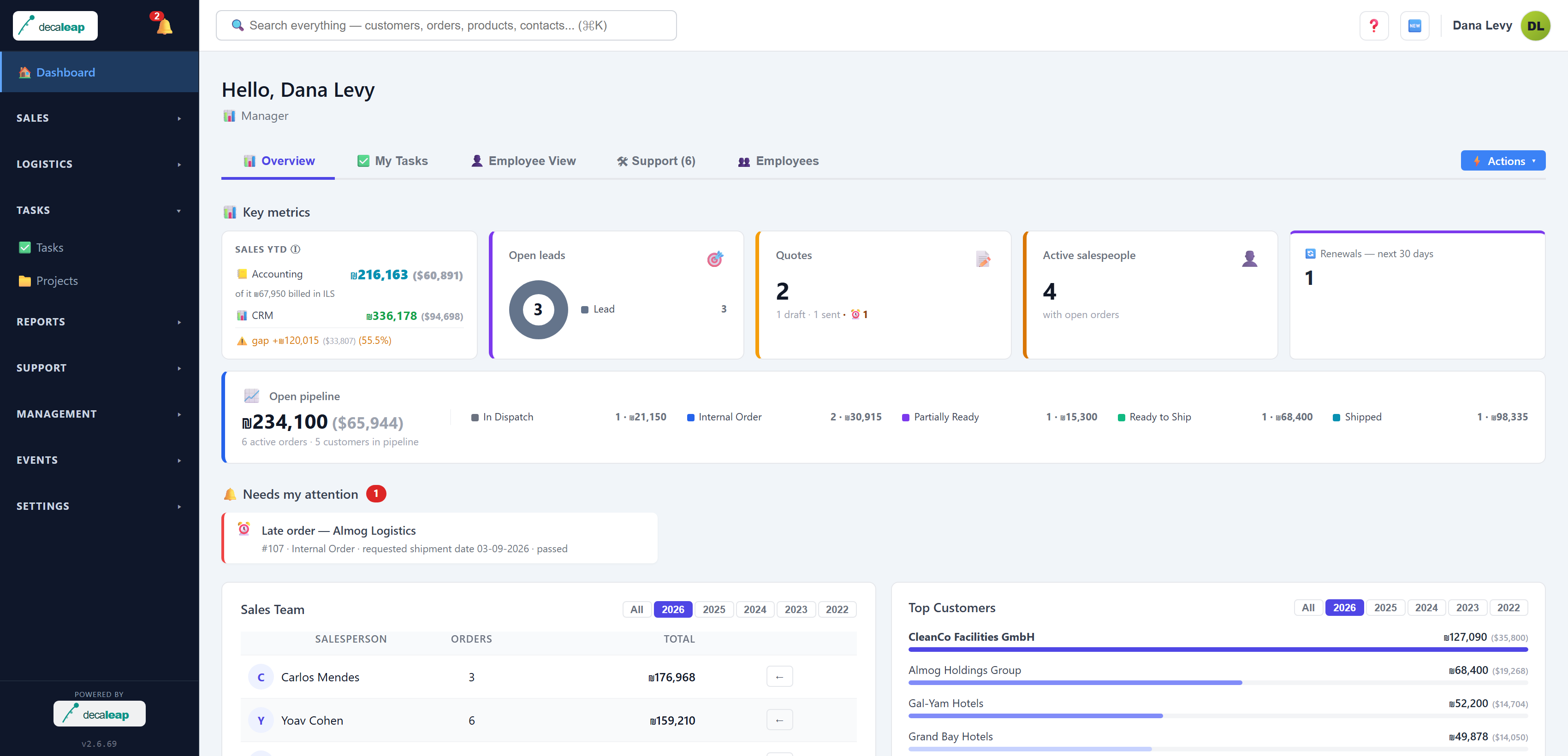
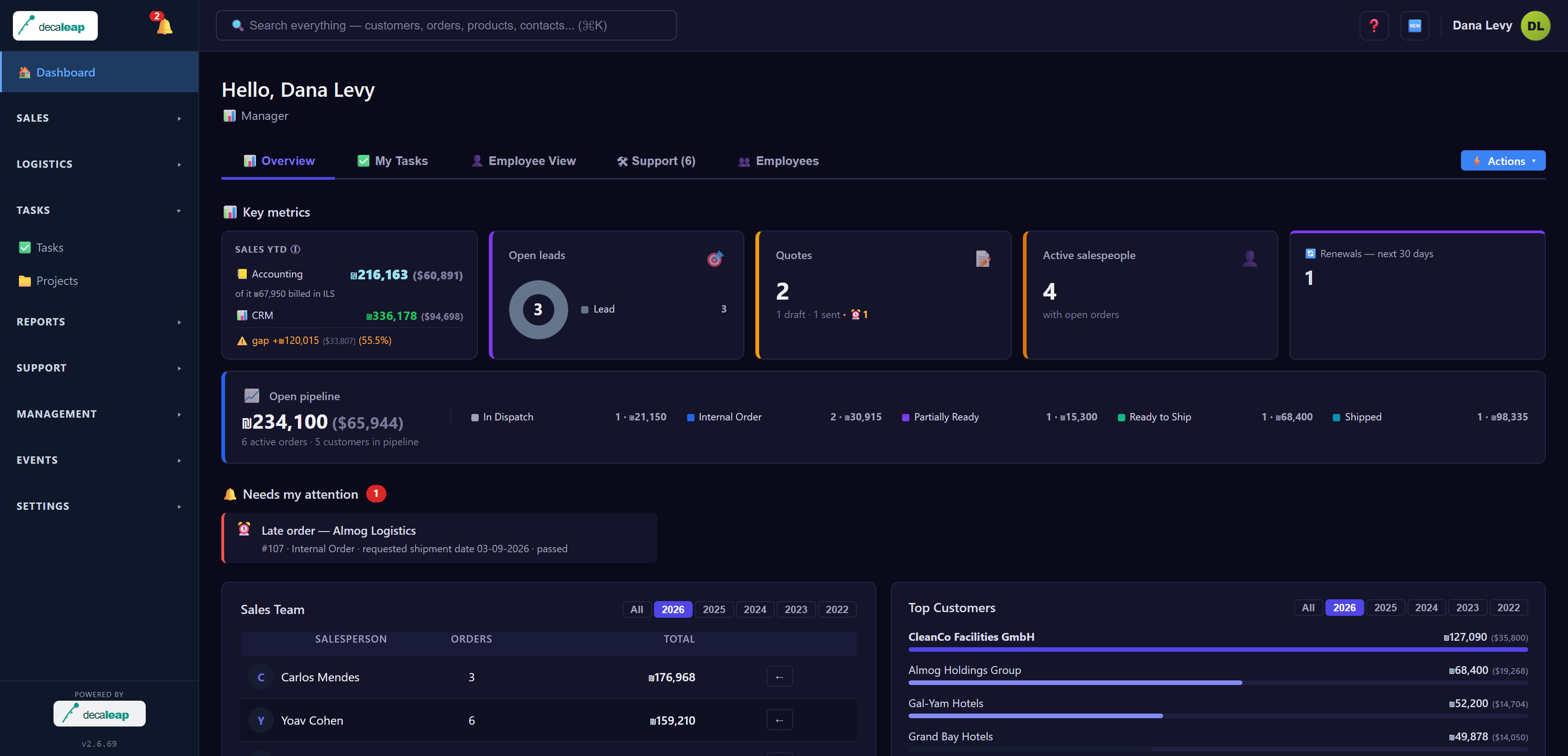
Dark mode is not a theme bolted on at the end — colours are semantic tokens, so every screen, table and document reads correctly in both. The switch belongs to the user, not the admin.
Two questions, and nothing to work out.
How many people will be in the system, and which edition matches how the business runs. One edition for the whole company, priced per user per month, and the price per user falls as the account grows.
Say who is in the system
Everyone who needs access gets a user. Nobody is counted twice, and nothing is added per document or per order.
Choose an edition
Solo if the business is not registered for VAT — receipts only, because that is all such a business may issue. Start for running sales and the books. Business when there is a service team and customers looking in. Trade when goods go out and there is a reseller channel.
That is the whole bill
The edition price times your headcount, and the price per user falls as the account grows. Inside the system, access is still granted per employee — so a warehouse operator does not see payroll.
Connects to what you already run.
Email with the customer is gathered into their record. Payment processing, Google sign-in, shipping rate zones, and a lead form that feeds the system straight from your website.
Start small.
Grow when you are ready.
A free trial with the whole system open, so you find out which edition you actually need rather than guessing. We help you import your data and configure your processes first — the clock only starts after that.
No credit card · cancel anytime